Analyze your microbiome data in hours, not weeks. No coding required.
One centralized omics operating system for wet lab biologists, bioinformatics teams, and R&D leadership.
- No-code, cloud-based. All you need is an internet connection and Google Chrome
- Pipelines up to 19X faster than GitHub alternatives, with comparative analyses generated in minutes
- Version-controlled pipelines for reproducible results across your team
- RITA, the AI co-pilot, helps you interpret results with fully referenced insights
Who is Cosmos Hub 2.0 for?
Choose the role that fits you best.
I'm a wet lab biologistExplore omics data and generate publication-ready insights — without writing code.I lead a bioinformatics teamDeploy standardized pipelines across the organization. Free your team for advanced science.I lead R&DTurn every study into reusable institutional knowledge. Accelerate discovery cycles.Users in over 30 countries around the world and across multiple industries and fields










What is Cosmos-Hub?
Cosmos-Hub is a no-code, cloud-based microbiome analysis platform designed to simplify complex bioinformatics studies. It brings together all the pipelines, data analysis tools, underlying statistical methods, and interactive visualizations you need for dependable, reproducible results—without the need for advanced coding or computational infrastructure.
Researchers of all backgrounds can now explore microbial communities and microbiome composition, thanks to an intuitive interface that makes data interpretation and collaboration simple while supporting extensible microbiome data science.
Get a full demo to learn about our software, then get started with a 14-day free trial to start unlocking the microbiome!
Book a Demo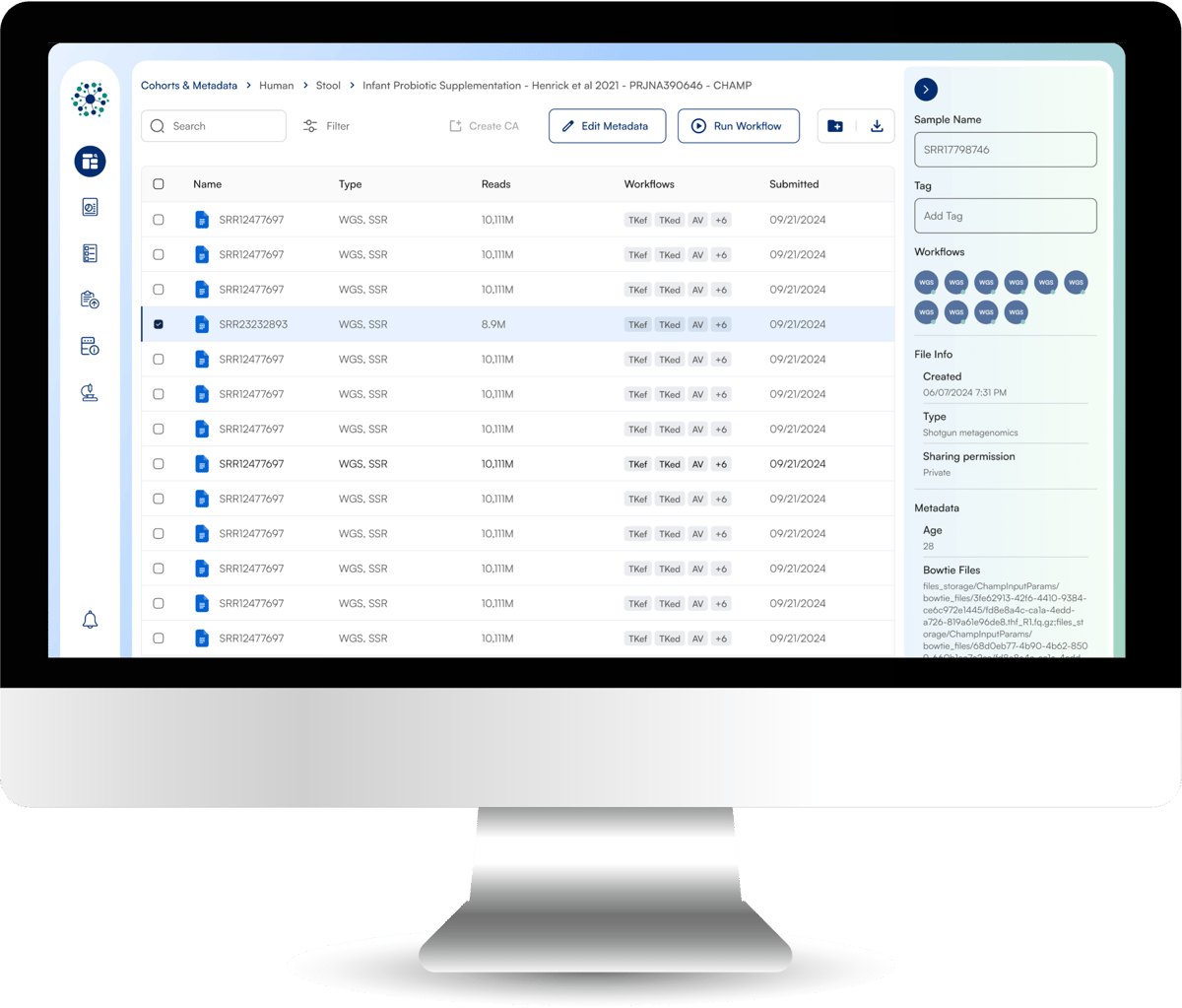
All of Your Microbiome Studies. One Easy Platform.
Cosmos-Hub brings together the latest bioinformatics pipelines for microbiome profiling, data storage & management infrastructure, comparative statistics and visualizations on the same platform. It’s easy to use, provides results quickly and gives a research team unified access to their study data. Each feature on the platform is powerful on its own. But, the real magic happens when you use them together to structure microbial communities data, run association analysis, and interpret complex microbiome composition patterns.

Microbiome Profiling
Industry-leading bioinformatics pipelines that let you analyze different types of sequencing data for multiple applications, from the gut microbiome to other complex microbial communities.
Popular Features
- Import fastq's directly via UI or CLI
- Analysis of 16S, ITS & Shotgun data
- Short & long-read compatibility

Statistical Analysis
Comparative analysis workflows that leverage your study metadata to create virtual cohorts and analyze them with the latest statistical tools and visualizations, supporting covariate adjusted analysis, survival analysis and control of false discovery rate.
Popular Features
- Interactive charts & visualizations
- Univariate statistics like LeFSe, Wlicoxon Rank-Sum & PERMANOVA
- Multivariate statistics like MaAsLin2 & MaAsLin3

Study Management
A study dashboards that provides integrated storage of raw data, profiling data, and study metadata for secure and easy access.
Popular Features
- Easy-to-navigate dashboard
- Upload and edit metadata directly
- Single-sample reporting & visualization

Cosmos-Hub Atlas
A curated database of over 40,000 microbiome samples, with metadata, that users can compare their samples against using beta diversity, alpha diversity indices and estimating population size metrics like incidence based coverage estimator and abundance based coverage estimator.
Popular Features
- Standardized profilings
- Curated metadata
- Results shared in 2-3 days

AI Co-Pilot
Cosmos-Hub's AI Co-Pilot, RITAi, supports the interpretation of results generated in the software by allowing researchers to make queries like when using their favorite GPT, combining domain knowledge along with their own research.
Popular Features
- Publication insights with complete references
- Species Wizard
- Support on how to use the Hub

Metabolomics Module (Early Access)
Import metabolomics data from any provider and conduct your analysis.
Popular Features
- Support for targeted and untargeted metabolomics
- Additional statistics and visualizations
- Multi-Omics Support
Microbiome Analysis Software Key Features
Cosmos-Hub lowers technical barriers by enabling comprehensive microbiome data analysis including amplicon and shotgun metagenomics, with compatibility for both short- and long-read technologies, supporting amplicon sequence variants and other microbial taxa outputs. Its no-code interface means researchers need no coding experience, promoting widespread microbiome research, profiling studies and human microbiome studies.

Meet RITA - Your AI co-pilot for microbiome data interpretation
Rapidly uncover detailed insights on organisms and biological pathways with RITA. This intelligent assistant delivers fully referenced context in seconds, accelerating your discovery workflow and enhancing data interpretation.
Learn moreCosmos-Hub agnostically supports data generated by all sequencing technologies



Key Benefits of Cosmos-Hub

Standardized & Reproducible
All pipelines are version-controlled with integrated reference databases, and individual comparative analyses are maintained and sharable, enabling complete reproducibility between team members and studies.

Integrated Data Management
Multimodal support for Amplicon and Metagenomic (both long-read and short-read) data-types. Raw sequencing data, profiling results, and study metadata are seamlessly linked for easy retrieval and cross-analysis.

No-Code Platform
Enables biologists and bioinformaticians to collaborate on studies together and democratize data analysis amongst the entire lab team.

No Specialized Infrastructure Required
Save costs on servers and specialized computers by leveraging Cosmos-Hub’s cloud infrastructure. All you need is an internet connection and Google Chrome. That’s it!

Superior Interpretation
By providing interactive charts & visualizations as well as an AI co-pilot named ‘RITA’, it’s never been easier to look at microbiome data in different ways and use the power of AI to help with interpretation and finding relevant references.

Secure and Compliant
Secure, compliant infrastructure, suited for RUO and clinical projects

Analyzed and Publish Faster
Cosmos-Hub pipelines perform up to 19X faster than GitHub alternatives with comparative analyses generated in minutes, allowing you to go from fast data to tangible insights in just a few hours.
Hear What Our Users Have to Say
“Cosmos-Hub is very user friendly and can rapidly generate informative and attractive figures from each dataset. We look forward to continuing to work with it in the future.”

“We've been using Hub for our analysis needs and it allows for detailed analysis and has allowed us to answer important clinical questions.”

“The biggest difference Cosmos-Hub has made for me is the ease of data handling and versatility of tools available, including LEfSe and MaAsLin3, which significantly reduces the time required to do the analysis on my own.”

“Their user interface for data analysis is a great tool for teams that need bioinformatics and analytical support.”

Want to run a few samples and test the pipelines?
Contact us below and a member of the team will reach out to arrange a call to discuss your project.
Our Latest Blogs
Enterprise Collaboration Tools for Omics R&D: What Research Teams Actually Need
Mo Langhi: Sep 9, 2026Omics R&D teams lose institutional knowledge every time a scientist leaves, a project transfers, or a study ends...
Read more6 min readIntroducing Cosmos-Hub 2.0: What’s New in the Omics Operating System
Manoj Dadlani: Sep 9, 2026Cosmos-Hub 2.0 is a centralized omics operating system that expands the original microbiome profiling platform into a...
Read more5 min read16S vs Metagenomics: What's the Difference?
Mo Langhi: Mar 10, 2026In the captivating world of microbiology, two primary methods have emerged to study the composition, structure, and...
Read moreFAQs
What types of data can I analyze on Cosmos-Hub?
Cosmos-Hub supports both amplicon and metagenomic raw sequencing data (FASTQ) produced by short-read and long-read technologies. Multiple pipeline integration enables in-depth study of human, non-human, and environmental samples such as gut microbiota, skin microbiota, vagina microbiota, environmental swabs and many many more. The platform is designed for comprehensive data analyses, including functional annotation and predictive functional profiling for cutting-edge microbiome research.
How does Cosmos-Hub help with comparing microbial communities?
By leveraging advanced tools for comparing microbial communities, Cosmos-Hub allows users to evaluate species and functional abundance data and visualize differences using popular statistical analysis tools and methodologies.
Can Cosmos-Hub assist in exploring links between the gut microbiota and human health?
Yes, Cosmos-Hub is designed to support research into the impact of gut microbiota on human health, including studies related to irritable bowel syndrome and metabolic conditions. Interactive workflows help map microbial ecological networks and interpret species abundance data relevant to clinical and translational research.