 Manoj Dadlani
Enterprise Collaboration Tools for Omics R&D: What Research Teams Actually Need
Cosmos-Hub 2.0: Enterprise-grade omics collaboration tools. Improve R&D productivity with governed data and shared workspaces.
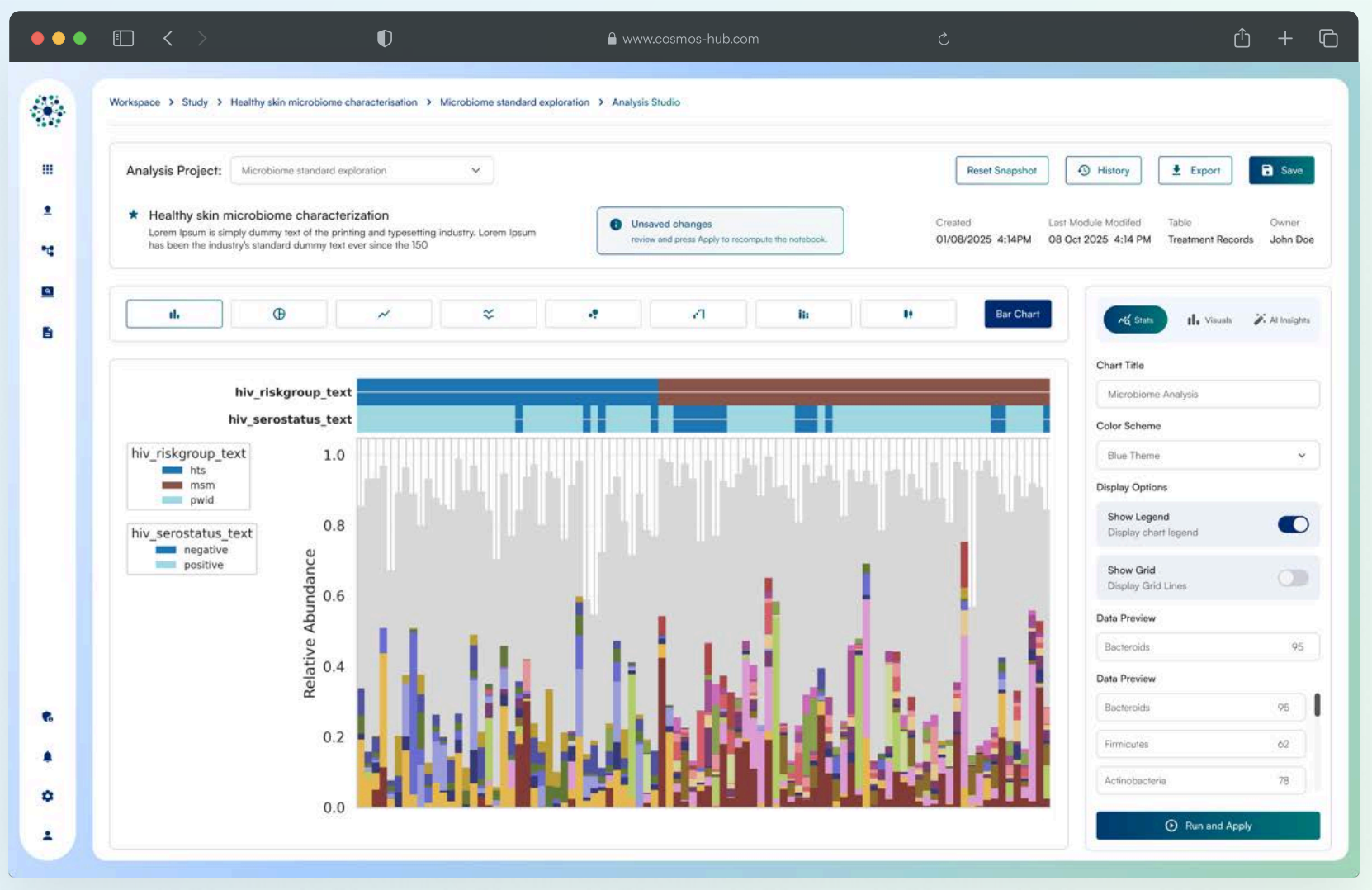
Cosmos-Hub 2.0 is a centralized omics operating system that expands the original microbiome profiling platform into a full multi-omics environment with 40+ statistical analysis tools, enterprise workspaces, and a governed data model built to turn every study into reusable institutional knowledge.
The platform, developed by Cmbio and used by more than 1,000 researchers across 30+ countries, now supports metagenomics, metatranscriptomics, metabolomics, proteomics, and custom feature tables from a single interface. The shift from version 1.0 to 2.0 is not an incremental update. It is a complete reimagining of how research organizations capture, share, and compound the value of omics data.
Cosmos-Hub 1.0 was a cloud-based microbiome profiling platform. Its statistical package covered standard microbiome exploration: heatmaps, stacked bar charts, PCA, diversity analysis, Wilcoxon rank sum tests, LEfSe, and multivariate statistics via MaAsLin2 and MaAsLin3. It supported raw data from shotgun metagenomics and 16S/ITS amplicon sequencing. Collaboration was limited to basic account-level sharing with no enterprise workspace option.
Cosmos-Hub 2.0 extends every one of those dimensions. The platform adds new omics data types, a substantially broader statistical toolkit, a flexible Analysis Studio, and a full enterprise collaboration and governance layer. The result is a platform designed to support the entire data-to-decision workflow, not individual analysis runs in isolation.
Cosmos-Hub 2.0 accepts raw data from shotgun metagenomics and 16S/ITS amplicon sequencing, along with custom feature tables for metagenomics, metatranscriptomics, metabolomics, and proteomics analyses. Research teams running multi-omics studies at organizations such as L’Oréal, Unilever, and Haleon can now centralize every data modality in one platform rather than splitting workflows across separate tools for each data type.
This consolidation removes a structural bottleneck. When metabolomics and microbiome data live in different environments, cross-modal analysis requires manual export, format conversion, and reconciliation. Cosmos-Hub 2.0 handles harmonization at the platform level, so researchers work with integrated datasets from the start.
The 2.0 statistics package adds advanced univariate abundance and prevalence statistics including Kruskal-Wallis, Dunn’s, Mann-Whitney U, Fisher’s, Barnard’s, and Boschloo’s exact tests with multiple-testing correction. Beta-diversity ordinations expand to cover t-SNE, MDS, and UMAP alongside existing methods, and rarefaction analysis now includes full rarefaction curves alongside PERMANOVA.
For predictive work, the platform introduces supervised classification using Random Forest, Logistic Regression, SVM, and Gradient Boosting. Regression modeling for continuous outcomes and multivariable association modeling via MaAsLin3 are available through a no-code interface. Metabolomics secondary analysis workflows complete the package, covering the full analytical surface that multi-omics research teams encounter across studies. All statistical methods are Cmbio-verified, giving research teams a governed, citable foundation for publication and compliance review.
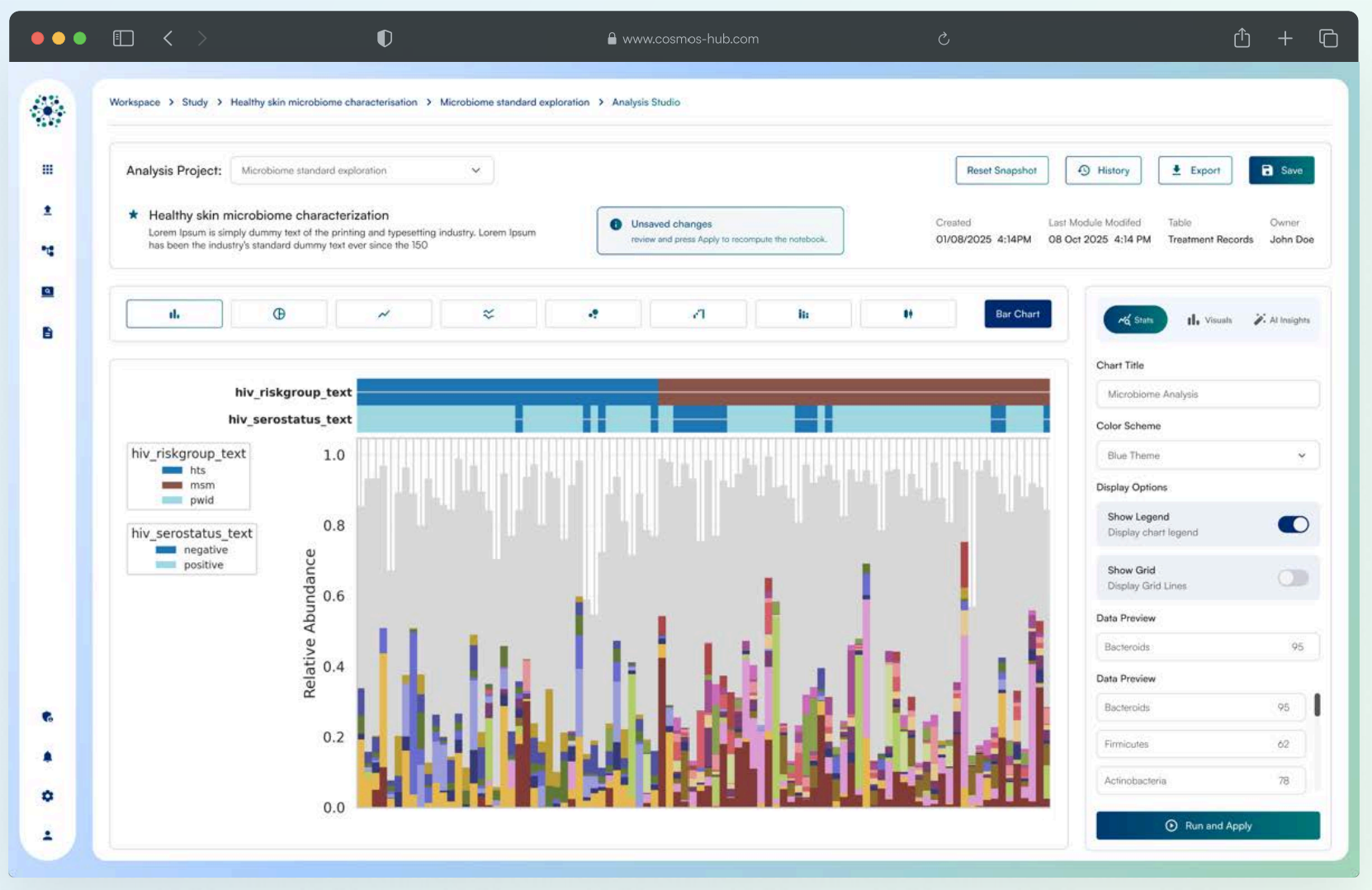
The Analysis Studio replaces version 1.0’s fixed output structure with a dynamic parameter input interface. Scientists experiment with statistical parameters and visualization options through a form-based UI without writing code. Parameters are adjustable in real time, and results update without requiring new analysis submissions.
For wet lab biologists, this means iterating on a hypothesis independently rather than submitting a revised request to a bioinformatics queue. For bioinformatics teams at institutions such as Harvard and Johns Hopkins, it means deploying verified frameworks that non-coders can operate without compromising the quality or reproducibility of the analysis. The Analysis Studio integrates directly with the platform’s version-controlled study management, so every parameter combination and its outputs are captured and auditable.
Compounding Scientific Intelligence is the mechanism by which every study run in Cosmos-Hub 2.0 strengthens an organization’s collective research foundation rather than producing a single isolated result. It operates through five stages: a new study generates results, the Cmbio Atlas provides comparable samples from a reference database of 150,000+ omics samples, validated analysis frameworks produce credible and repeatable insights, those insights become decision-ready evidence, and the learning loop captures signals and reusable assets for the next study.
The practical difference from the status quo is significant. Most research organizations treat each study as a standalone project. Findings are reported and stored as files. When the scientist who ran the analysis leaves, or the project transfers, the context for how decisions were made disappears with them.
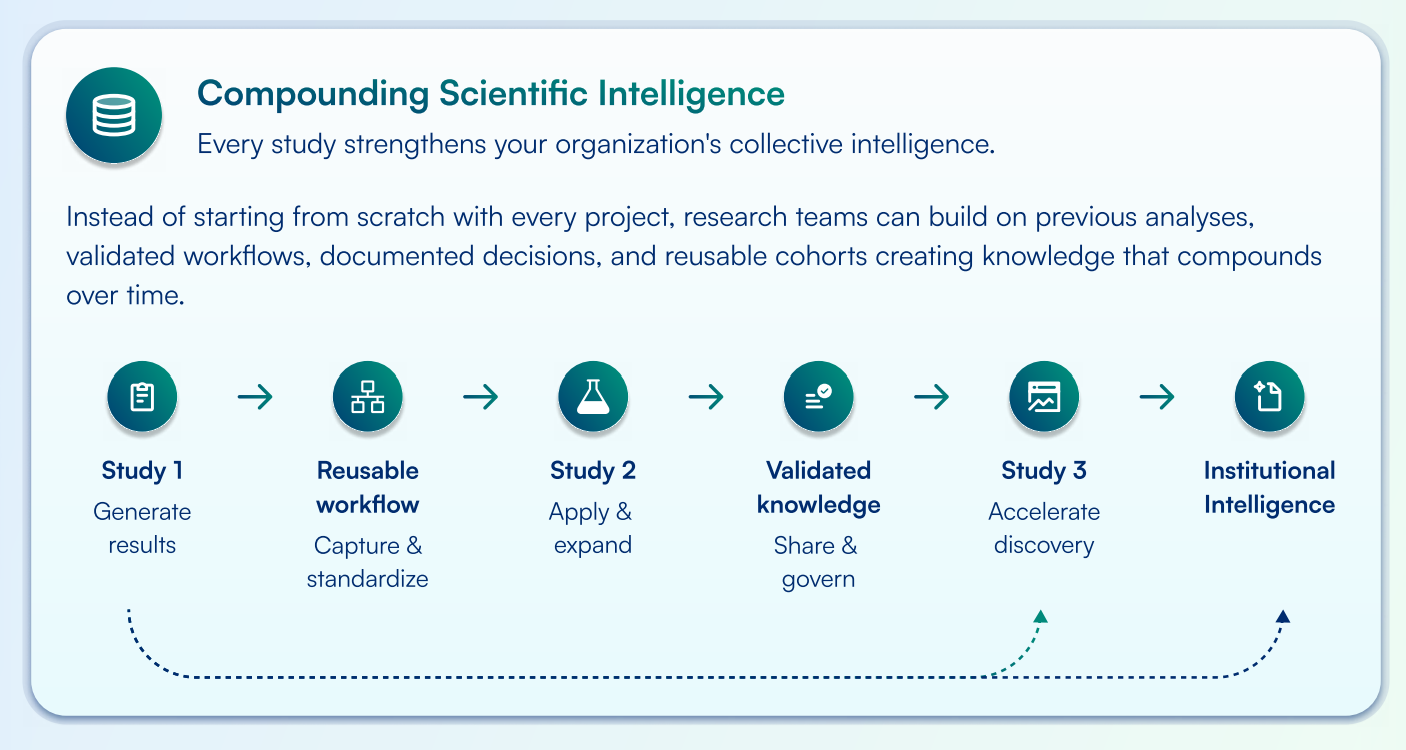
Compounding Scientific Intelligence, Cosmos-Hub 2.0
Every study run in Cosmos-Hub 2.0 is captured in a governed environment with full provenance tracking: analysis steps, parameter choices, intermediate results, and the reasoning behind decisions. Studies become searchable, reusable, and available to future researchers at the same organization without manual reconstruction.
The study and data management module structures this capture at the workflow level. Reusable cohorts, validated workflows, and documented decisions are not stored as static files. They are maintained as version-controlled organizational assets that improve in quality each time a team builds on them. This is the difference between knowledge that compounds and knowledge that decays.
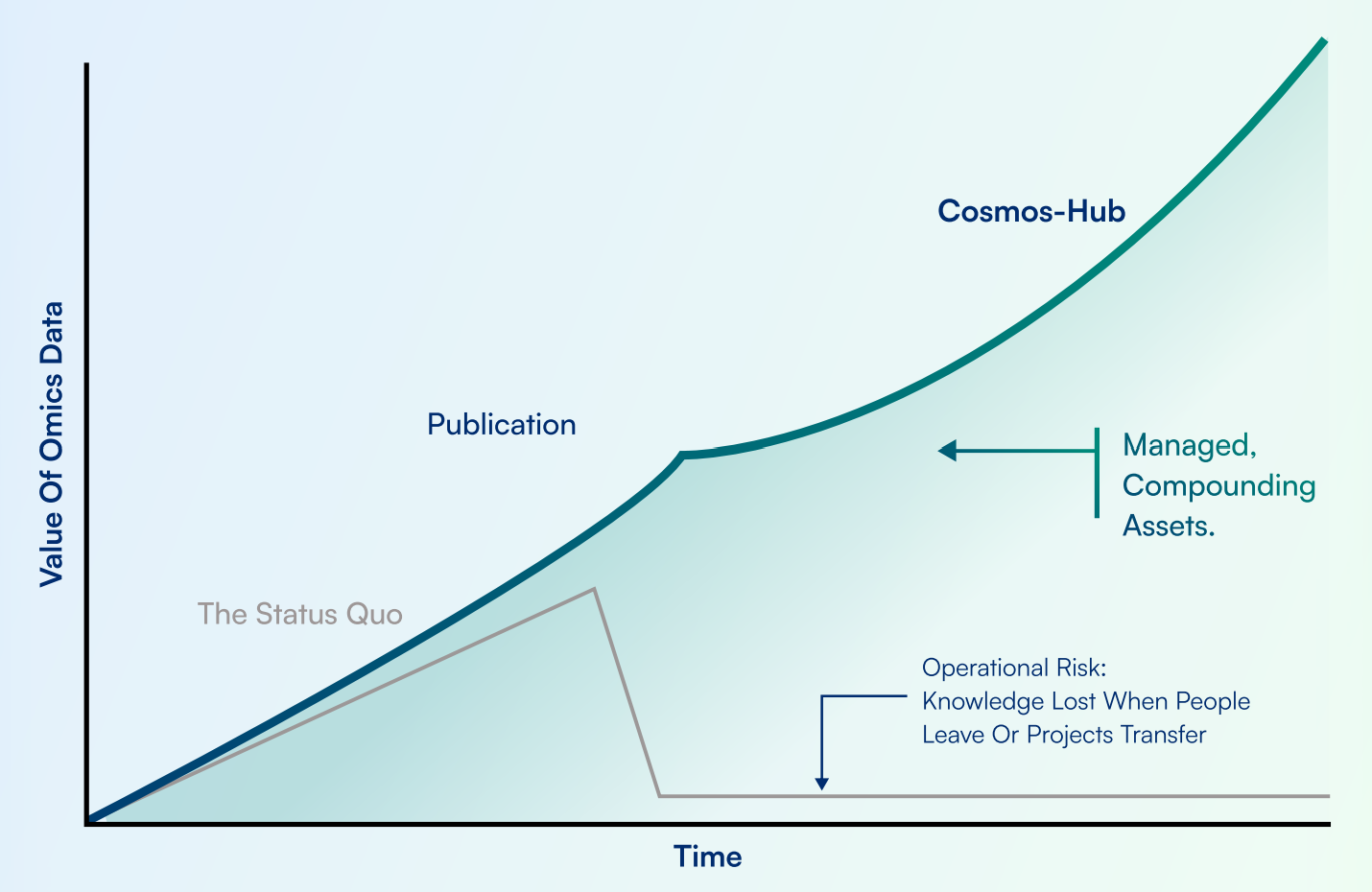
From Analysis to Institutional Knowledge, Cosmos-Hub 2.0
Cosmos-Hub 2.0 is designed around three research roles, each with distinct needs the platform addresses in parallel.
The FDA, Oxford, and Haleon use Cosmos-Hub alongside academic and pharma teams at more than 6400 samples profiled and 43600+ analyses completed across the platform’s user base. That scale of usage across distinct organizational contexts makes the platform’s multi-role design practical rather than theoretical.

Designed for every role across the research workflow, Cosmos-Hub 2.0
Cosmos-Hub 2.0 introduces enterprise workspaces with granular user permissions, shared study environments, and version control at the study level. The enterprise solutions layer is designed for organizations running multi-team or multi-site research programs where quality control, reproducibility, and compliance are non-negotiable requirements.
Yes. Cosmos-Hub 2.0 supports Single Sign-On and Multi-Factor Authentication as standard enterprise security features. Access controls operate at a granular level, allowing administrators to define who can view, edit, or run specific studies, pipelines, or datasets.
Yes. The platform is built on AWS infrastructure with GDPR-aligned permissions and full provenance tracking. Every analysis is documented, timestamped, and auditable. For pharmaceutical and CRO organizations working with regulated data, the compliance architecture is built into the platform rather than retrofitted as an add-on.
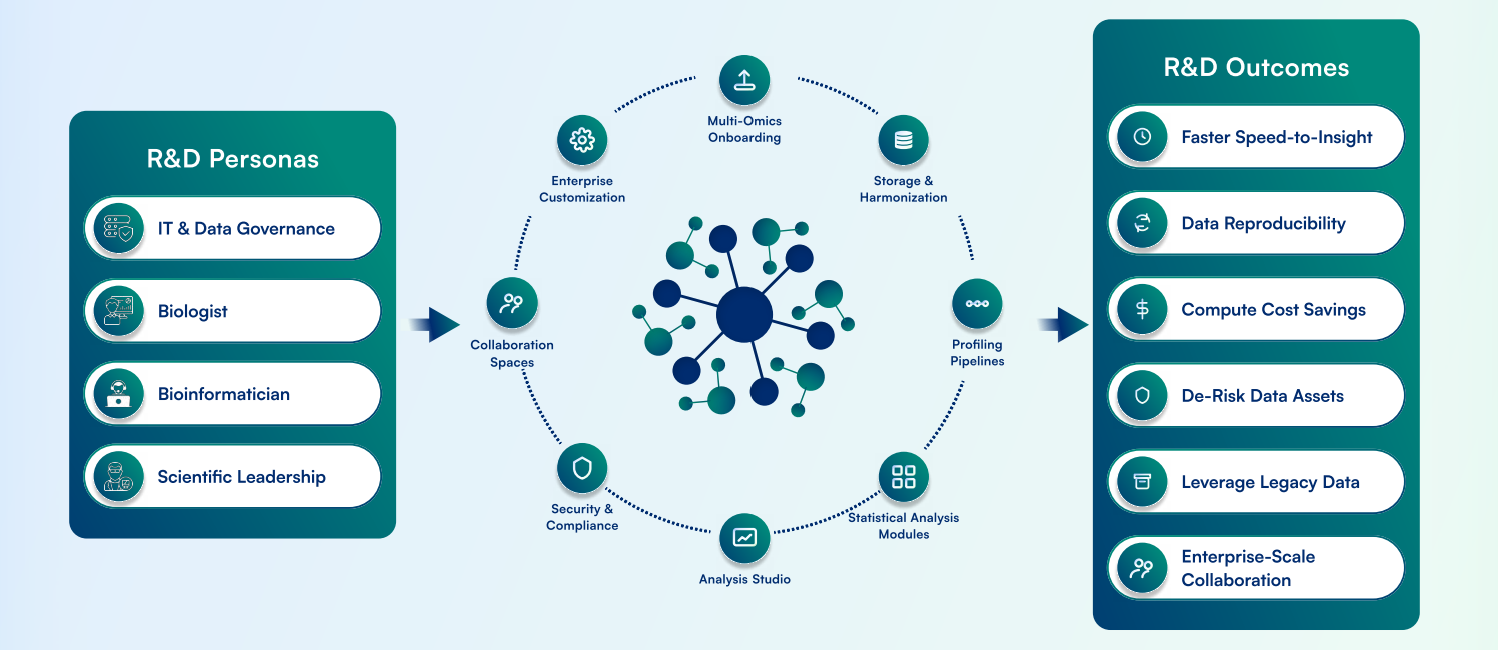
R&D Personas & Outcomes, Cosmos-Hub 2.0
The primary competitive alternatives to Cosmos-Hub 2.0 are R Studio, QIIME2, Galaxy, BaseSpace, One Codex, Omics Playground, and AWS plus internal pipelines. Each addresses a subset of what Cosmos-Hub 2.0 provides as a unified system.
R Studio and QIIME2 require scripting expertise and ongoing maintenance. Galaxy and BaseSpace cover workflow execution but do not provide the enterprise governance or institutional knowledge layer. One Codex and Omics Playground offer no-code analysis for specific modalities but are not designed as multi-omics operating systems. AWS plus internal pipelines provide infrastructure but place the entire analytical and governance burden on internal teams.
The gap is concrete when a research team needs to add metabolomics to an existing microbiome study. QIIME2 has no native metabolomics support; teams running both data types must maintain a separate analytical environment for metabolomics — R packages such as MetaboAnalyst or Bioconductor are common choices — then manually export results from each tool, reconcile sample identifiers, and harmonize data formats before any cross-modal analysis is possible. Cosmos-Hub 2.0 accepts both data types in the same platform, handles harmonization at the point of upload, and allows researchers to run cross-modal analyses from a single interface without leaving it.
Cosmos-Hub 2.0 closes the gap that each of those options leaves open: a governed, multi-omics platform that scientists can use without code, IT teams can trust without building infrastructure, and research leaders can rely on to preserve institutional knowledge rather than losing it when projects transfer or people leave.
Test it out today to see how Cosmos-Hub 2.0 fits your organization’s omics research workflow.
Cosmos-Hub 2.0 harmonizes messy omics data from multiple data sources, including metagenomics, metabolomics, proteomics, and metatranscriptomics, at the point of upload rather than leaving reconciliation to individual researchers. The platform turns scattered files and isolated datasets into a structured, governed environment where biological data from different modalities can be analyzed together without manual export or format conversion. This means research teams stop collecting data across disconnected systems and start building a compounding scientific foundation from a single omics OS cloud environment.
As molecular biology research generates more biological data than ever before, artificial intelligence requires structured, reusable institutional knowledge to produce meaningful outputs. Cosmos-Hub 2.0 is built around this reality: every study is captured with full provenance tracking, turns scattered files and isolated analyses into version-controlled assets, and gives precision medicine teams a foundation they can query, build on, and compound across programs. The result is a governed data environment that makes omics research AI-ready rather than leaving it fragmented across disconnected pipelines and siloed data sources.
Early access to Cosmos-Hub 2.0 is available for existing Cosmos-Hub customers, offering first access to new capabilities including microbiome, metabolomics, and machine learning modules before general availability. Participants receive locked-in pricing for 2 to 3 years, a lifetime discount on their current plan, and dedicated onboarding plus scientific consulting hours with the Cmbio team. Customers joining through early access also gain direct input on the product roadmap, including the option to co-develop a feature with Cmbio.
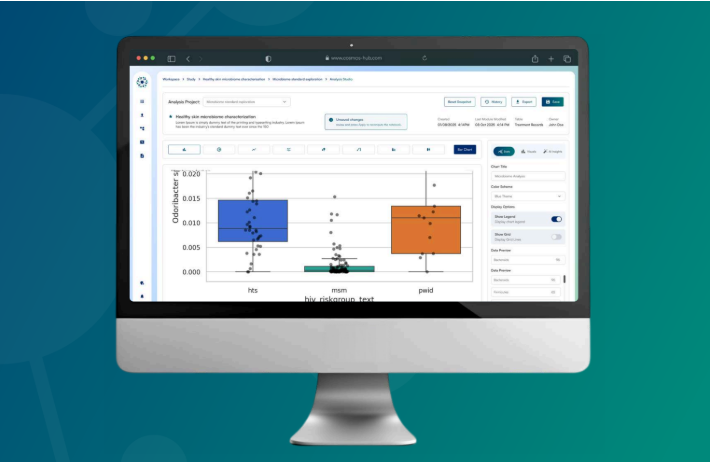
Cosmos-Hub 2.0: Enterprise-grade omics collaboration tools. Improve R&D productivity with governed data and shared workspaces.
Discover essential insights on the relationship between cancer and the gut microbiome from our expert-led comprehensive guide.
What is the difference between 16S and metagenomic sequencing? Discover all you need to know in our expert guide.