

Microbiome Profiling

Streamline Microbiome Profiling with Cosmos-Hub

Cosmos-Hub allows researchers to import their raw sequencing data directly into the platform and run a number of available bioinformatics pipelines for microbiome analysis.

microbiome profiling page-1
Icon

Omics Data Platform for R&D Leaders

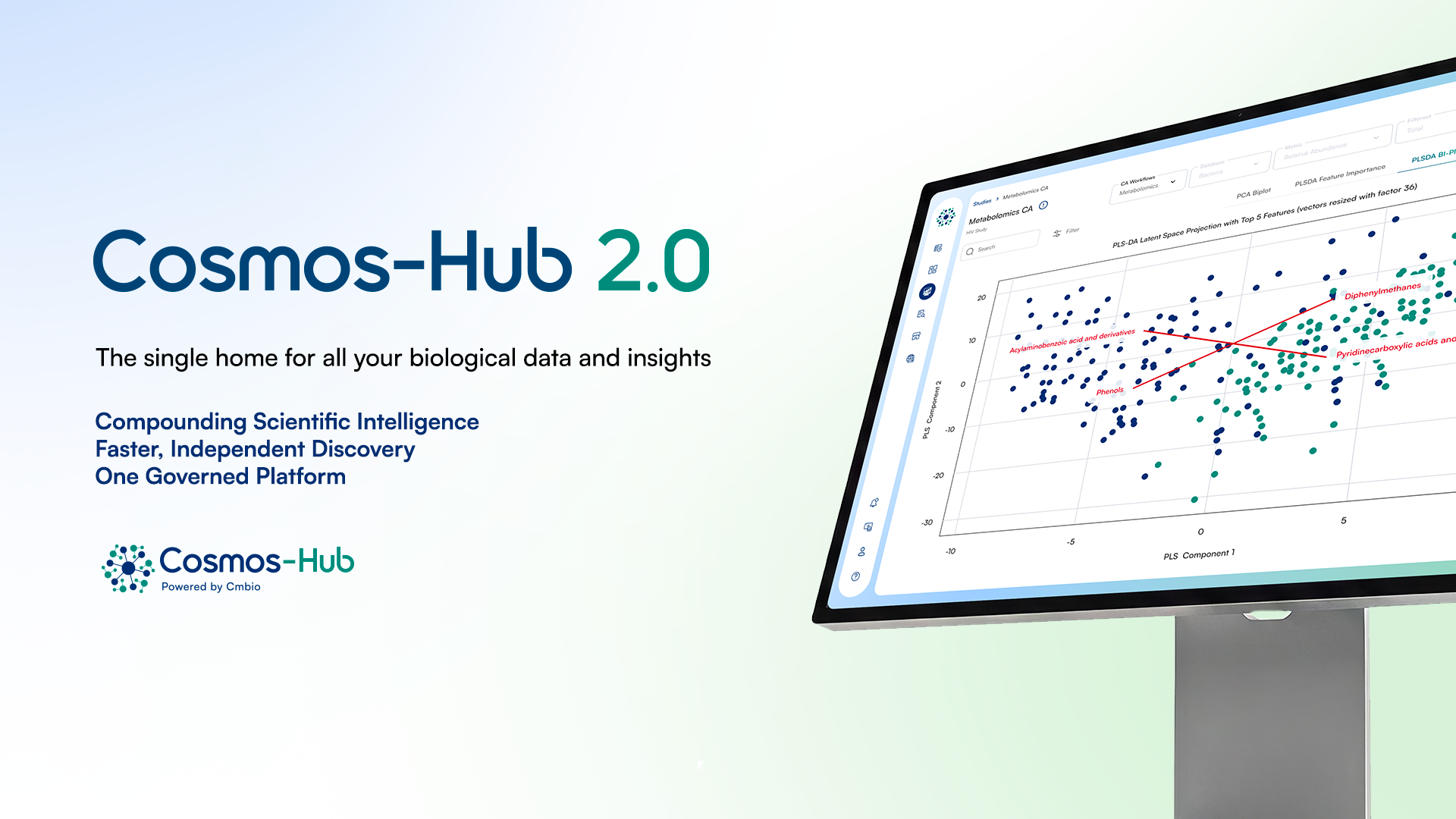
Cosmos-Hub 2.0 makes every one of your studies a compounding asset.

Most research organizations treat each study as a one-time result. Cosmos-Hub 2.0 transforms them into managed institutional knowledge, accelerating future study design, strengthening evidence generation and reducing the cost of doing science well.


The cost of disconnected research infrastructure.

”We have spent years generating data. But every time we need to answer a new question, we start from scratch as if that data does not exist.”

”When a senior scientist leaves, we lose months of context about how analyses were run and what decisions were made.”

”Our bioinformatics team is perpetually overloaded with routine requests, and our scientists are perpetually waiting. Neither group is doing their best work.”

Cosmos-Hub 2.0 was built to change the economics of research at the organizational level.

Microbiome Profiling

Streamline Microbiome Profiling with Cosmos-Hub

Cosmos-Hub allows researchers to import their raw sequencing data directly into the platform and run a number of available bioinformatics pipelines for microbiome analysis.

Microbiome  Profiling
 

In just a few easy steps, users can run industry-leading bioinformatics pipelines for a wide range of different data types:

  • Import data from their computer, from Illumina BaseSpace, directly from NCBI SRA or via Command Line Import (CLI).
  • Select the type of data they’d like to import: Shotgun, 16S or ITS
  • Select from 1 of 9 different host genomes to run automated host read depletion
  • Upload your study metadata
  • Choose your pipeline and primers
 

In just a few easy steps, users can run industry-leading bioinformatics pipelines for a wide range of different data types:

  • Import data from their computer, from Illumina BaseSpace, directly from NCBI SRA or via Command Line Import (CLI).
  • Select the type of data they’d like to import: Shotgun, 16S or ITS
  • Select from 1 of 9 different host genomes to run automated host read depletion
  • Upload your study metadata
  • Choose your pipeline and primers
Microbiome  Profiling
icon4-1

1. Accelerate time from data to decision

Cosmos-Hub 2.0 shortens the path from data generation to decision-ready evidence by eliminating the bottlenecks that slow it down, chiefly the dependency on a small, overloaded bioinformatics team. When scientists can analyse independently and findings are centralized, every stage of the discovery cycle moves faster.

icon5

2. Retain institutional knowledge permanently

Every study run in Cosmos-Hub 2.0 becomes a managed organizational asset, with full provenance, reasoning and analytical context documented and searchable. When scientists move on, projects transfer, or teams reorganize, the knowledge stays. Your organization never starts from zero again.

icon8-2

3. Improve data and findings reuse across programs

Data generated in one program should inform the next. Cosmos-Hub 2.0 makes historical datasets, analytical frameworks and findings discoverable and reusable across programs, teams and partners, without the friction of tracking down files or calling a former colleague. Backed by the Cmbio Atlas, a 150,000-plus sample reference dataset that adds external context to your internal studies.

infraicon

4. Scale scientific output without scaling headcount

Cosmos-Hub 2.0 multiplies the effective output of your existing scientists. Wet lab biologists gain analytical independence. Bioinformaticians focus on advanced methods. Leaders gain clearer visibility into data, analysis, and scientific progress. The organization runs leaner and produces more.

WHAT CHANGES WITH COSMOS-HUB 2.0?
 
 
Traditional Omics Analyses With Cosmos-Hub 2.0
Studies are one-time events. Findings stored in files and reports that nobody revisits. Every study becomes a documented, searchable, reusable organizational asset.
Data reuse requires tracking down the original analyst and hoping the code still runs. Historical data is discoverable and reusable without manual effort or archaeological digs through shared drives.
Bioinformatics is a bottleneck. Scientists wait. Discovery cycle times suffer. Scientists analyse independently using verified frameworks. Bottlenecks dissolve. Cycle times shorten.
Institutional knowledge lives in people's heads and leaves with them. Every analysis is centralized, documented, and retained regardless of team changes or restructures.
Analytical quality varies by team, tool, and individual. Results are not always comparable. All analyses run on standardized, version-controlled frameworks. Quality is consistent and auditable across the organization.


Step 1: New study or refined hypothesis

Interrogate biology, discover biomarkers, assess interventions.


Step 2: Cmbio Atlas

Find comparable samples, cohorts, and outcomes from 150,000+ existing data points to strengthen study design and statistical power.

Step 3: Analysis frameworks

Turn data into credible, repeatable, standardized insights using Cmbio-verified and organization-built pipelines.

Step 4: Decision-ready evidence

Package go/no-go logic and the rationale for next steps in a format that supports confident decisions.

1,000+

users worldwide

30+

countries

600K

samples profiled

170k

analyses completed

“The biggest difference Cosmos-Hub has made for me is the ease of data handling and versatility of tools available, including LEfSe and MaAsLin3, which significantly reduces the time required to do the analysis on my own.”

Nezar AI-Hebshi, PhD, Temple University

Cosmos-Hub agnostically supports data generated by all sequencing technologies
Illumina_Inc._Logo0 8e6bbfdd1b0656f6be95528a15ffc4ea elemBio-greenhouseLogo MGI-new-logo-1024x455 pacbio oxfordhighreslogo

SEE COSMOS-HUB 2.0 IN ACTION, BUILT FOR YOUR WORKFLOW

 We will walk you through how Cosmos-Hub 2.0 addresses the specific research infrastructure challenges your organization is facing, with data on how similar organizations have shortened discovery cycles and reduced operational risk. No generic demos. No sales pressure.

Frequently Asked Questions