The Role of Gut Microbes in Weight Loss
We highlight a recently published paper in the Nature Communications journal that challenges the notion that all calories contribute equally to...
7 min read
Omics R&D teams lose institutional knowledge every time a scientist leaves, a project transfers, or a study ends without capturing the analytical reasoning behind its results.
Cosmos-Hub 2.0 addresses this with enterprise collaboration tools built specifically for multi-omics research: shared workspaces, version-controlled studies, granular user permissions, and a governed data model that makes every completed study a reusable organizational asset.
The platform, developed by Cmbio and trusted by research organizations including L’Oréal, Unilever, Haleon, Harvard, Johns Hopkins, and the FDA, is used by 1,000+ scientists across 30+ countries running over 6400 analyses on 43600+ profiled samples.
The collaboration gap in omics R&D is not a communication problem. It is an infrastructure problem. When pipelines live in individual scripts, findings live in email attachments, and institutional knowledge lives in the heads of scientists who eventually move on, no amount of team coordination resolves the underlying fragmentation. What research organizations need is a platform that makes collaboration structural rather than effortful.
Explore Cosmos-Hub 2.0 For R&D Teams | Book a Demo
The core collaboration failure in omics research is that the tools used to generate insights are not the same tools used to share, govern, or preserve them. A bioinformatician builds an analysis pipeline in R or Python. Results are shared as exported figures and reports. A decision is made. The pipeline is archived locally or, more often, simply left in the analyst’s own working directory until they move to the next project.
When that analyst leaves, or the project transfers to a new team, reconstructing the analytical context takes weeks and frequently proves impossible. The Cmbio product team identified this pattern directly through client collaboration when designing Cosmos-Hub 2.0: research organizations were generating more biological data than ever, but scientific knowledge remained fragmented across disconnected workflows, one-off analyses, and isolated datasets.
Institutional knowledge is lost in every research organization that stores it in people rather than platforms. A bioinformatician who has spent 18 months developing a validated metabolomics analysis framework carries that framework in their head, their local scripts, and their personal folder structure. When they leave, the organization retains the data but loses the methods, the parameter choices, the rationale, and the months of iteration that produced a reliable result.
Cosmos-Hub 2.0 prevents this by capturing every analysis in a governed environment with full provenance tracking. Every workflow step, parameter combination, intermediate result, and documented decision is stored and searchable at the organizational level. The study and data management module treats studies as persistent organizational assets rather than one-time project outputs. When a scientist leaves, the knowledge stays.
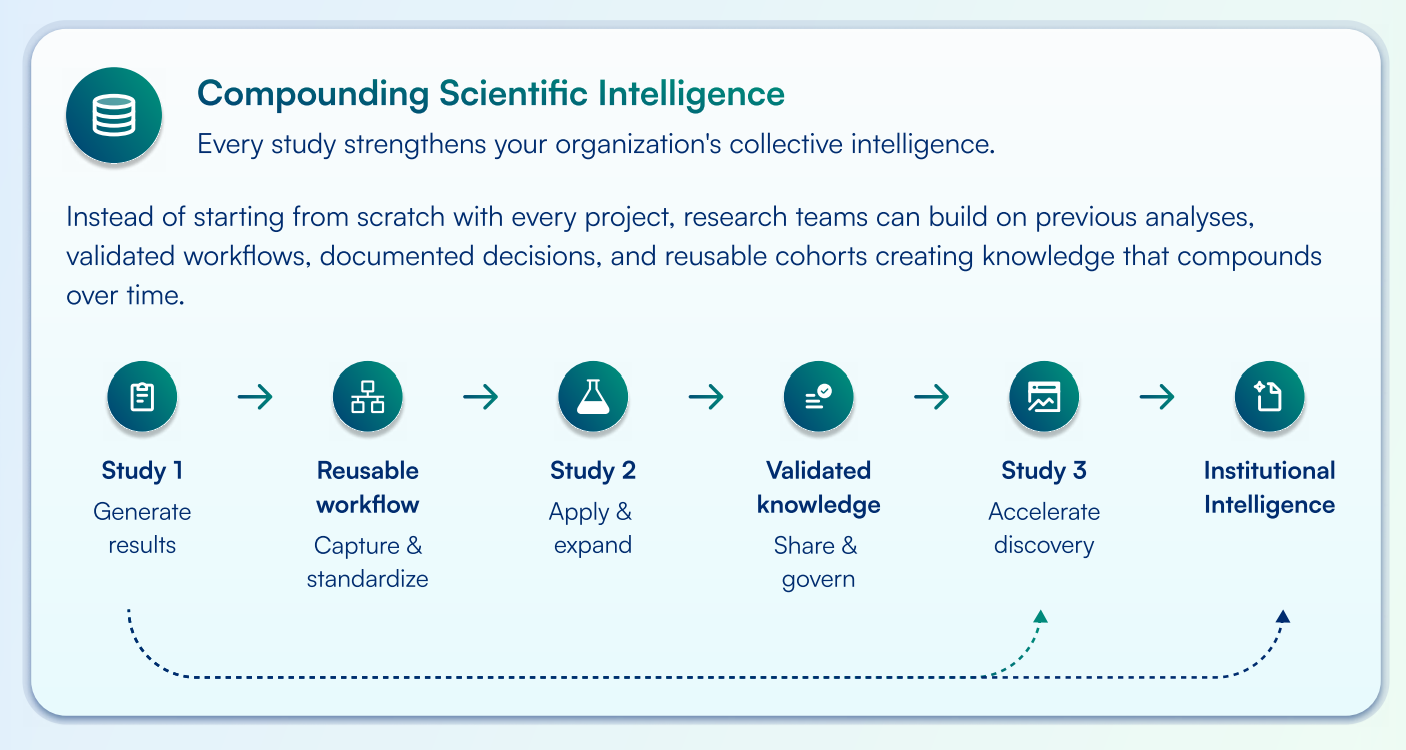
Compounding Scientific Intelligence, Cosmos-Hub 2.0
Bioinformatics teams in omics R&D organizations function as a shared analytical service for wet lab scientists who cannot code. Every new analysis, every revised figure, every repeat of a prior workflow passes through the same small team. The result is a queue that grows faster than it shrinks, slowing discovery cycles for the entire organization.
The bottleneck is not a capacity problem in isolation. It is a structural problem: wet lab scientists with scientific questions have no route to answers that does not pass through a coding intermediary.
Cosmos-Hub 2.0 resolves this by giving bioinformatics teams a way to publish their validated frameworks as organizational resources that non-coders can run independently. The queue does not just shrink. It eliminates a whole category of requests that should never have required a bioinformatician in the first place.
The enterprise solutions layer in Cosmos-Hub 2.0 is built around three capabilities: shared workspaces, version control, and granular permissions. Together they create the infrastructure for governed, reproducible collaboration across teams, research centers, and business units.
Enterprise workspaces are shared environments where multiple team members work on the same studies, datasets, and analysis frameworks with defined access levels. Unlike basic file-sharing or account-level access in Cosmos-Hub 1.0, workspaces in 2.0 are structured around studies as objects. A study workspace contains the data, the pipeline configurations, the parameter choices, the results, and the documented reasoning, all in one place, accessible to every authorized team member.
For organizations running multi-team programs at scale, such as pharmaceutical companies running parallel microbiome and metabolomics programs across multiple research centers, this structure eliminates the coordination overhead of reconciling separately managed analysis environments. Every team member works from the same source of truth.
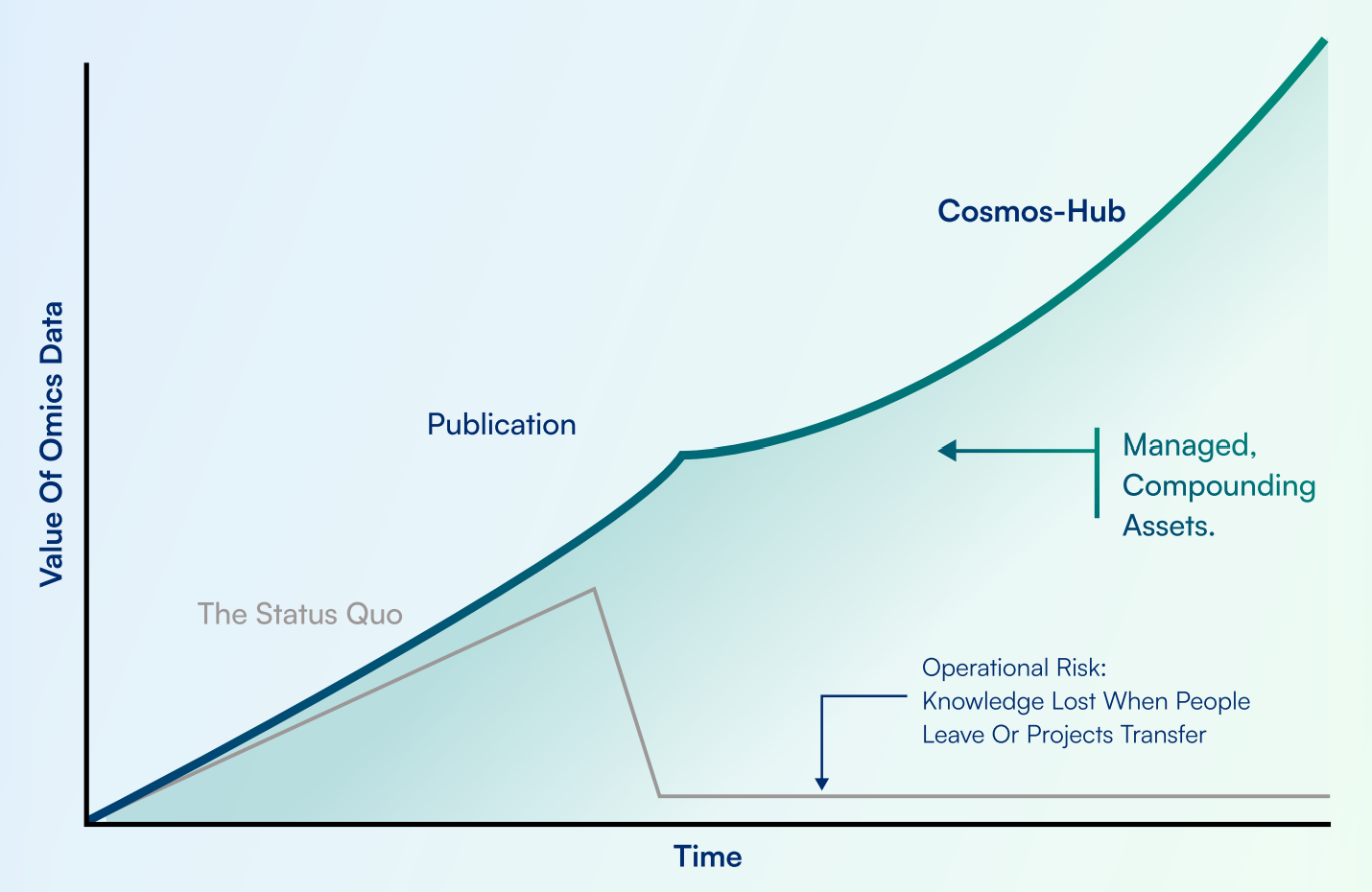
From Analysis to Institutional Knowledge, Cosmos-Hub 2.0
Version control in Cosmos-Hub 2.0 operates at the study and pipeline level, tracking every change to analysis configurations and outputs with a full audit trail. When a bioinformatics team updates an analysis framework, the previous version remains accessible. Teams can trace exactly when a change was made, who made it, and what the outputs were under each version.
This matters for publication and compliance review. Pharmaceutical organizations working with regulated data need a complete, auditable record of how analyses were run. Cosmos-Hub 2.0 provides that record automatically, as part of the normal workflow, without requiring analysts to maintain separate documentation or manual version logs. All pipelines are built on AWS infrastructure with GDPR-aligned permissions and full provenance tracking.
Yes. Cosmos-Hub 2.0 supports attribute-based user permissions at a granular level, allowing administrators to define read, edit, and execute permissions separately for individual studies, datasets, and pipelines. SSO and MFA are supported as standard enterprise security features, making the platform compatible with the identity management systems that pharmaceutical and biotech organizations already use.
Granular permissions are particularly important when bioinformatics teams publish analysis frameworks for organization-wide use. Teams can define exactly which parameters non-coders can adjust and which are locked, maintaining analytical quality control while giving wet lab scientists genuine operational independence.
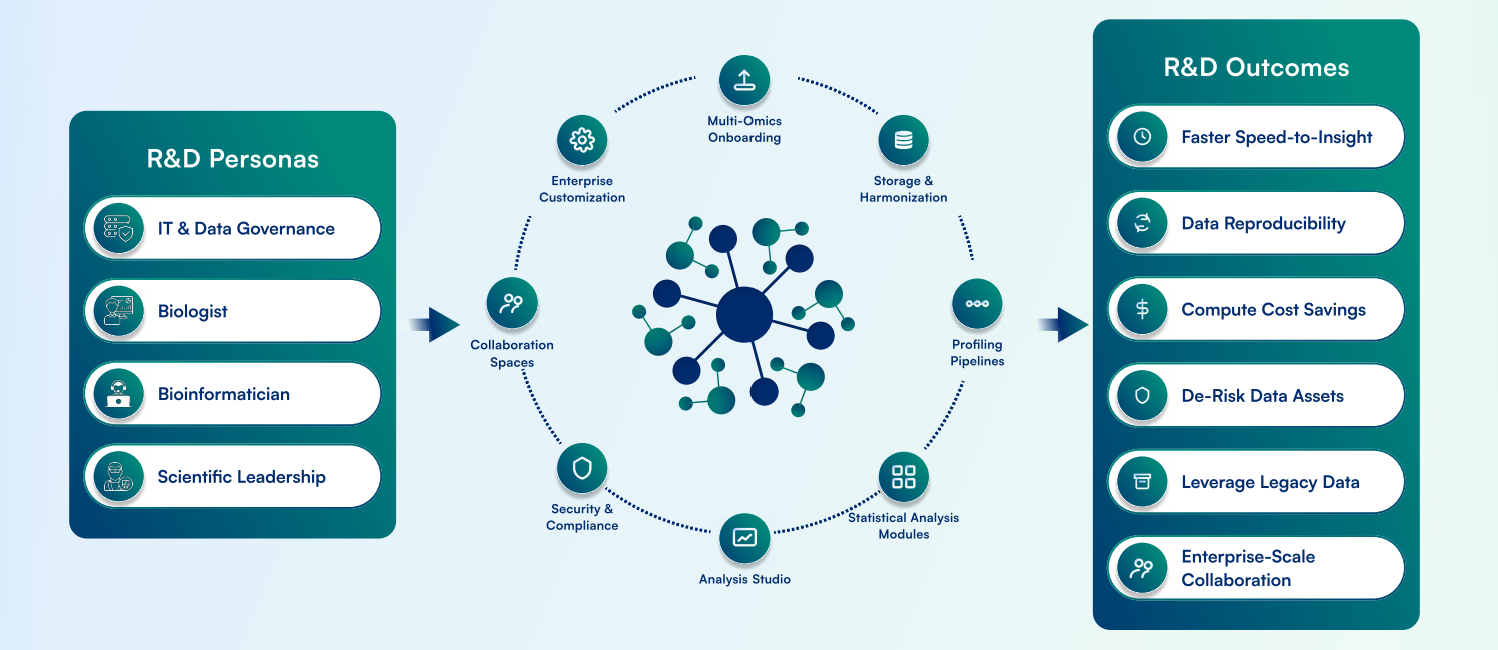
R&D Personas & Outcomes, Cosmos-Hub 2.0
Cross-team research programs generate a specific set of collaboration problems: different teams running similar analyses with different tool versions, findings that live in team-specific folders rather than a shared organizational library, and no mechanism for one program to build on the validated outputs of another. Cosmos-Hub 2.0 addresses all three.
Yes. Bioinformatics teams build analysis pipelines and visualization frameworks in Cosmos-Hub 2.0 once, then publish them as organizational resources accessible to any team or research center with defined access permissions. A metagenomics pipeline validated by the core bioinformatics team at one research center becomes immediately available to wet lab scientists at three others, running on the same version, producing reproducible results, without any additional configuration or support from the original developers.

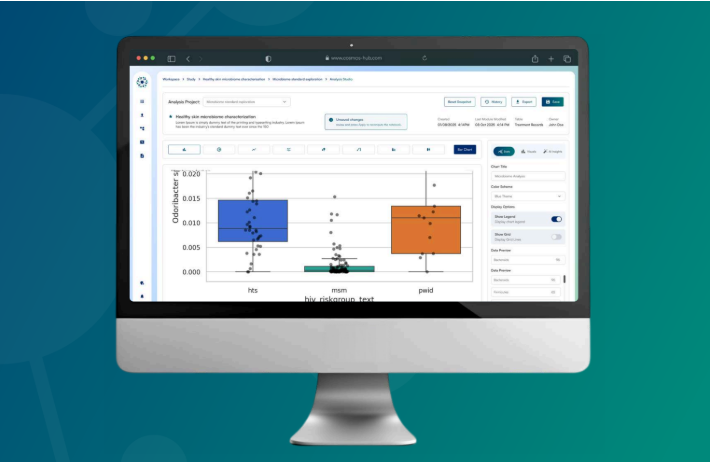
Analysis Studio, Cosmos-Hub 2.0
Yes. The platform is purpose-built for research organizations running omics programs across multiple teams, sites, and business units. Enterprise workspaces support separate team environments within a single governed organizational instance, meaning each team works independently while the leadership layer retains visibility and control across all programs. R&D leaders at organizations such as Unilever and Haleon use this structure to accelerate discovery cycles, improve data reuse across programs, and reduce the operational risk that comes from knowledge loss when people or projects change.
Open-source tools such as QIIME2, Galaxy, and R plus Bioconductor give bioinformatics teams analytical flexibility but generate exactly the collaboration problems Cosmos-Hub 2.0 is built to solve. Pipelines exist as scripts in individual repositories. Results are shared as files. Version control, when it exists at all, requires additional infrastructure such as Git, without any integration into the analytical environment itself. Governance and compliance are manual layers that research organizations add themselves.
The practical consequence is visible in a common scenario: a bioinformatics team lead leaves the organization, and a new analyst inherits the project six months later needing to reproduce the pipeline. In a QIIME2 and Git stack, that means locating the original conda environment specification, matching plugin versions that may no longer be hosted at the same source, tracing parameter choices from commit messages or external notes that may not exist, and re-running the pipeline without any guarantee the outputs match what was previously published.
In Cosmos-Hub 2.0, the same pipeline is version-controlled and documented within the platform. Any authorized team member re-runs it with identical parameters on the same platform version and produces the same result, with no reconstruction required and no dependency on the person who built it.
For IT and data governance teams reviewing platforms for pharmaceutical or regulated research environments, open-source stacks require substantial internal infrastructure investment before they meet enterprise security standards. Cosmos-Hub 2.0 provides SSO, MFA, GDPR-aligned permissions, provenance tracking, and full version control as part of the platform, not as configurations the organization builds on top of it.
Enterprise-ready security in an omics platform means the compliance architecture is structural, not optional. In Cosmos-Hub 2.0, every analysis is documented, timestamped, and auditable. Access controls are attribute based and managed at the study and pipeline level. Data lives on AWS infrastructure with the configuration required for GDPR-aligned operations. SSO integrates with existing organizational identity providers, and MFA adds a second authentication layer without requiring IT teams to build custom access management.
For R&D organizations where data governance is a regulatory requirement rather than a preference, this means the platform passes IT review without modification. For scientific leadership, it means a complete, defensible record of how every study was run exists by default, from the first data upload to the final published output.
Ready to see how Cosmos-Hub 2.0 fits the collaboration structure of your research organization? Contact our team to discuss your specific program requirements, or book a demo to see the enterprise workspace and governance layer in action for your omics workflows.
Explore Cosmos-Hub 2.0 For R&D Teams | Book a Demo
Cosmos-Hub 2.0 functions as a collaborative platform where data management is built into the structure of how research is conducted, rather than left to individual scientists or separate tooling. Research data, including pipeline configurations, parameter choices, and documented decisions, is stored in a governed, version-controlled environment that all authorized team members can access from a single source of truth. This means that research materials generated across collaborative research projects, whether at one site or several, remain searchable and reusable as organizational assets rather than siloed in individual folders or local scripts.
Cosmos-Hub 2.0 offers 40+ flexible statistical analysis modules for data analysis across metagenomics, metatranscriptomics, metabolomics, proteomics, and custom feature tables, making it a unified environment for integrating multi-omics data without switching between disconnected tools. Bioinformatics teams can build and publish validated analytics tools as shared organizational resources, allowing bench scientists to run data analysis independently through an intuitive no-code interface. The Cmbio Atlas reference database of 150,000+ omics samples also connects each study's research data to comparable external evidence, strengthening the scientific credibility of every result.
Cosmos-Hub 2.0 provides enterprise grade security as a structural component of the platform, with SSO, MFA, GDPR-aligned permissions, and full provenance tracking built in by default rather than configured as optional add-ons. Data storage runs on AWS infrastructure designed for regulated environments, indexing research data into a secure organizational data lake with complete audit trails covering every data analysis step from first upload to final output. For IT and data governance teams evaluating a collaborative platform for pharmaceutical or clinical research collaboration, this means the platform passes security review without modification and every item of research data and research materials produced within it carries a complete, defensible record.
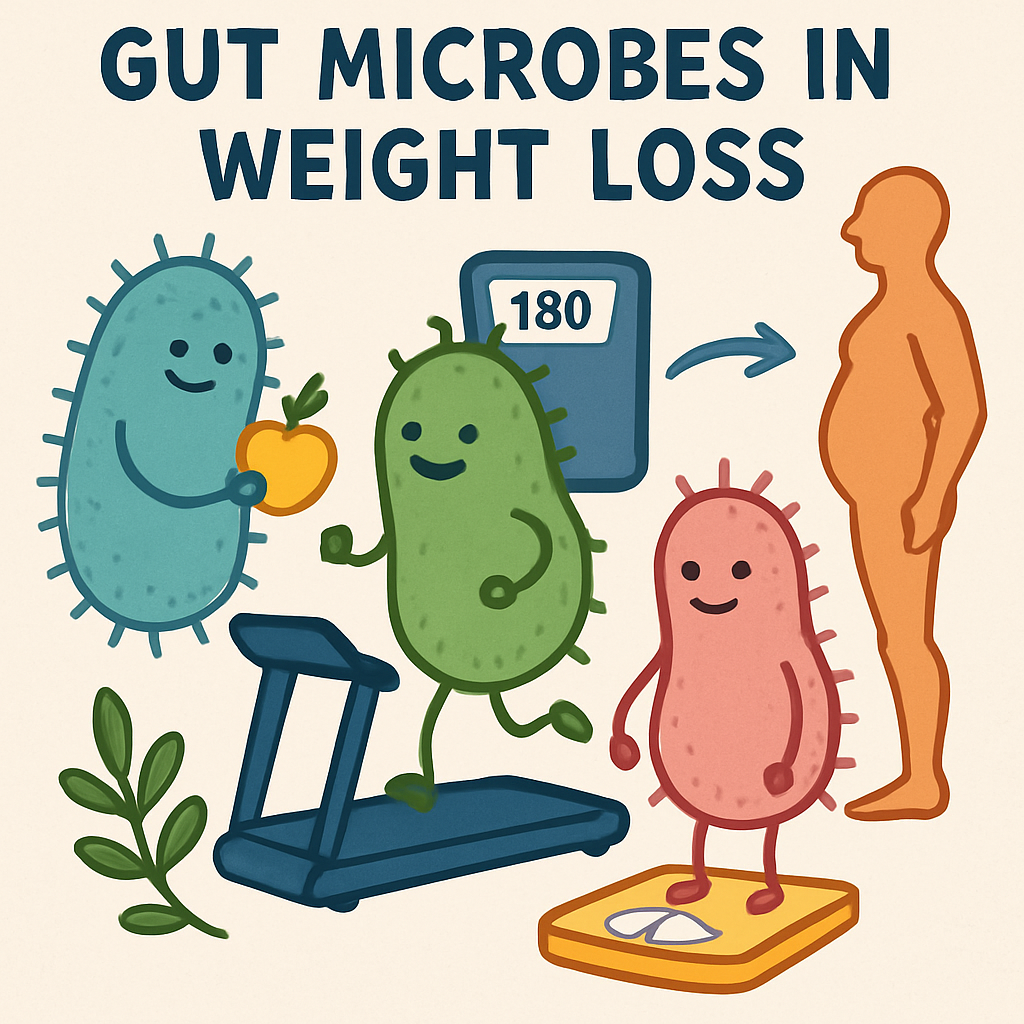
We highlight a recently published paper in the Nature Communications journal that challenges the notion that all calories contribute equally to...
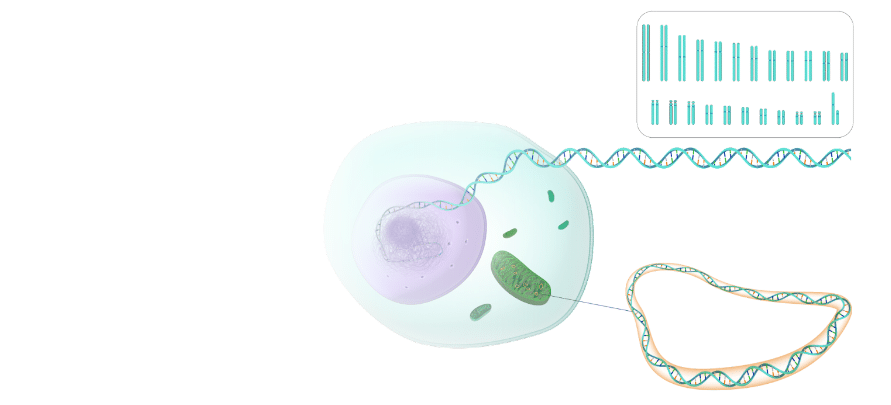
Metagenomics vs genomics: discover the definitions, applications and key differences of both today in our complete guide.
Discover essential insights on the relationship between cancer and the gut microbiome from our expert-led comprehensive guide.